I thought you all might find this interesting and insightful. I know that Informationalism is not explicitly atheist; my closest examination has led me to conclude that Spinoza-like Pantheism or weak Atheism are probably the best approaches to Informationalism. I posit a simple redefinition of the terms so that Atheism and Pantheism become one.
I feel this movie links up my last post, because it shows the harm that can come from forcing unfounded dogma onto children. I would not even condone labeling a child as a Informationalist child. It is a matter of choice that must be made at an age of consent.
I'm showing this in the hopes that all of you will take an opportunity to take another look at your own faiths; to try and discover where you may be dogmatic. I'm asking, as always, that you consider the benefits of the possibilities that come with Informationalism. Finally, it is my hope that some of you might decide to help pick up the cause, and embrace this progressive philosophy.
2/24/2007
Richard Dawkins - "There is no such thing as a Christian Child"

2/18/2007
Why Our Country Needs Informationalism
I think this article says it all my friends:
http://news.yahoo.com/s/ap/20070218/ap_on_re_us/evolution_jews
Here is the website: http://www.fixedearth.com/
State Rep. Ben Bridges of Georgia has been affiliated with a memo passed around the political scene which decries Science and attempts to replace it with the Pseudoscience of a man named Marshall Hall. Hall is the President of the "Fair Education Foundation". The name of the organization itself is an example of the disinformation that those frightened of the freedom of information will promote. There is no fair education for this man, there is only the age old
To sum up this ridiculous website promoted by a ridiculous excuse for a representative. It attempts to show the public how the modern model of the universe and evolution are mere products of a "zionist agenda". Of course, one wonders why they chose to lump these two areas of study together specifically. It is because they are both threats to Christianity.
Informationalism wishes to promote the freedom of information. There is no problem with the creation of such information, the problem is that this website parades incorrect information as correct information. By doing this it also engages in disinformation. The result? A deliberate misleading of the public. This website is fraud; it is an example of all that a society without freedom of information can be subjected to.
A final thought. Imagine if a child who knew little about the subject were to stumble upon this website. The influence that it could have upon their ability to think critically would be catastrophic. For the sake of free information and free society we must let it be known that fraud and disinformation cannot be tolerated.
2/13/2007
The seminar on the situation in 
The city of
However, the city obviously had planned to grow, and so decided expansion and drainage of the swampland in coordination with development would be the best strategy to take. They undertook the paradox that the speaker referred to as making unsafe land safe. The swamp land was drained, causing the dried up soil to compress and sink below sea level. It was then placed behind levees for protection that were only designed to withstand category 3 Hurricanes.
The danger was realized, and the city was sued for failing to adequately maintain the pump systems to keep the water out. However, the development of
The area that had been swamp land which was developed quickly flooded as it was already under sea level. It should be noted that the area built on the natural dunes was spared a large amount of the destruction. The levees could not withstand a category 4 Hurricane, and so they broke. Since the levees were made in one large wall, a single breech caused the water to pool in the area below sea level and then become stuck, prolonging the flooding. This was also combined with failure to communication between the national and local level of government.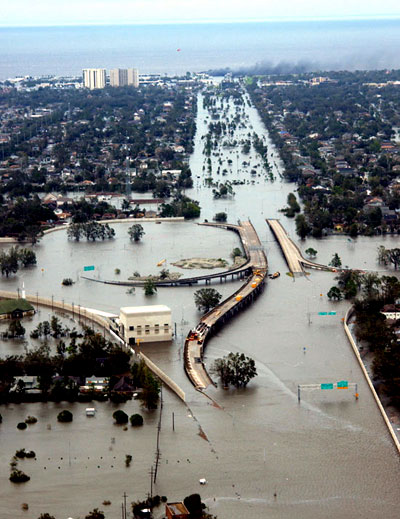
The results were that thousands were killed, billions of dollars in damage was suffered, and thousands of people were left homeless and forced to move outside of the city. All of this could have been avoided with proper planning.
1/30/2007
Sprawl and Sustainability
This post is dedicated to the ideology behind a favorite blog of mine called, A Green Earth. In this post I will talk about Urban Sprawl and environmental sustainability, it will be connected with Informationalism by its focus upon teachers. Most everyone is aware of the critical role that teachers play in the realm of information. Here I will show how helping them advances informationalism, improves urban life, and helps the environment.
It has been incorporated into common knowledge for quite some time that a large pool of labor is critical to a wealthy society. It provides the basis for competitive industry and is the powerhouse behind a market economy. City, State, and National governments recognize this in the
However, it appears at all levels the externalities of these workers’ wages are not taken into account. Failing to pay a wage that makes it viable to live comfortably in the city has many negative consequences. If the wages are extremely low, the workers must live in slums with high crime rates and health issues. Also, if the wages are raised but not adequately enough for all, then there is greater incentive for the workers to reside outside the city. This situation contributes to sprawl, which results in a longer commute and greater energy consumption. Also, if the residence is outside the city or county, revenue paid out to the workers is lost on the local economy. So, despite the universal acknowledgement of the value of workers, their low wages make fighting sprawl more difficult and detract from the local economy. Yet it does not seem to be a factor in planning.
Many city planners in the 21st century have come to regard the idea of sustainability as essentially good. As always, since humans are so fond of dualisms, the “good” of sustainability finds its antithesis in sprawl. Both of these are fairly loaded terms, and so it is essential to provide a clear and concise definition of the two in order to avoid conceptual ambiguity and understand the nature of the labor paradox.
Sprawl can best be understood as the result of the expansion of an urban area into the less
Sustainability, on the other side of the duality, is the product of careful planning. However, the concept itself is separated by schools such as new urbanism, which also seeks to fight sprawl, by its incorporation of ecological systems in the planning calculations. Sustainable planning seeks to take into account the amount of human population an area can hold while maintaining adequate resources for the planned future. This means not only reversing the tendencies of sprawl, but also managing resource allocations of goods such as: water, petroleum, electricity, food, and land. The goal of sustainability is to ensure that the resources are allocated efficiently enough in the present so they are not completely consumed or unequally diminished for future generations.
From these definitions it is clear that not addressing the issue of the labor force is contradictory to good planning and to sustainability, as it promotes sprawl and inefficient utilization of natural resources. For example, in one of the areas known for the worst sprawl, Charlotte North Carolina, a first year teacher with a bachelor degree is paid $28,510 by the state (Salary, 2007). It is difficult for the teachers, since it takes an average of $35,000 dollars to meet the basic needs of a family of four (Glasmeier, 2008). Common sense would lead one to deduce that the teacher would not locate themselves in a city with a higher cost of living.
The negative affects of this policy are also supported in a paper published by Rèmy Prud’homme and Chang-Woon Lee where they defined the efficiency of cities based upon labor productivity. In their study of 23 French cities they found that the success of the city was defined by the relative size of its labor market, which was determined by, “…the size of the city; the average potential job-home distance (sprawl); and the average speed at which journey to work takes place” (Prud’homme and Chang-Woon Lee, 1998 ). These last two are specifically the problems that face the city as a result of their inadequate payment of the labor force. The paper concludes specifically that, the city’s productivity is determined by the aforementioned factors, and that this labor pool is determined by, “…its sprawl and of the speed at which trips to the cities are made”, (Prud’homme and Chang-Woon Lee, 1998 ).
It should also be noted that the increased distance from the job denotes a greater reliability on automobiles. These automobiles add further crowding to the already busy city streets and have spiraling negative consequences for the city system. Thus, it is clear that it is not possible to confront sprawl or sustainable planning without addressing the wages of workers. The wages must be raised to a level that makes it possible and then beneficial for workers to live in areas relatively close to their schools. The economic loss incurred by keeping the wages of the labor force low ultimately outweighs the state funds saved in the process.
References
Glasmeier, Amy K (2006), An Atlas of Poverty in
Beatly; Manning (1997), The Ecology of Place,
“Charlotte-Mecklenburgh Schools 2006-2007 Salary Schedule for Teachers” (2006), http://www.cms.k12.nc.us/departments/HR/compensation.asp, accessed February 2, 2007.
Rèmy Prud’homme and Chang-Woon Lee (1998), “Sprawl, Speed, and the Efficiency of Cities”,
1/21/2007
Why We've Been Failing in
The critics of the 
So after tens of thousands of lives and a trillion dollars, why haven't things come together?
I've already outlined a plan to get us out of
Why has Bush's vision failed?
The Bush Administration has suffered from ethnocentrism in the
The truth, however, is more sobering. People have to be educated to live in a representative democracy. Tolerance and equality and representation are far from instincts, they are acquired disciplines. This is what makes Informationalism so important. The sharing of Information is the only way we can discover the things that work towards the progress of our species; it is the only thing that can keep us from giving into our infantile impulses and eventually destroying ourselves and those around us.
The Bush Administration has thrust democracy on
What must be done?

The people must be empowered. However, you cannot empower them with the vote if you do not first empower their mind. To empower their mind you must ensure that their mind and body are sound, which means they must not be wanting for food or water or the various basic resources that humans in chaotic situations must struggle in terror to acquire.
This returns us to Informationalism. Education. The Iraqi people cannot be "forced to be free" in the words of Rousseau. They must be taught to be free. In order to be taught to be free they must have a time and a place to learn. We are not providing that, and all the prime minister wants is the guns to settle the dispute once and for all.
The dispute will never be settled with guns. Force does not make right. Perhaps blood must be spilled to begin the process, but it can never be completed with blood. It must be completed with minds.
I would encourage all of you who read this blog to tell all those that you know that education is the way out of
1/17/2007
Parts of Informatonalist Plan Informally Considered
I outlined in an earlier post my plan for getting out of Iraq if we were not going to begin an immediate phased withdrawal. It is pleasing to me to notice that some of the international figures of political authority are considering elements from the plan I presented.
1. I commented on the first, which was that unrestricted warfare against the militias was needed. The Bush Administration and the Iraqi prime minister have set out to do just that. However, I do not believe the commitment of the prime minister is genuine, as he appears to just be using this operation as an excuse for an ethnic cleansing of the Sunni. If that part of my plan is to be adopted, the United States must take a more independent approach of dealing with the Shi'a death squads. They are the power base of the Shi'a Prime Minister, and he will not undermine his own power base.
Now, however a more recent development has taken place involving the government of Saudi Arabia. Here is the link http://www.msnbc.msn.com/id/16656642/
The Saudi government is talking about sending troops into Iraq, because like I said, the Shi'a dominated government is not going to be able to quell the violence, as its supporters are instigators of the violence. This begins to follow the part of my plan that calls for the phased withdrawal of US troops and their replacement with UN peacekeepers and help from the Arab League.
This is for any of you that are skeptical, as you should be, of the benefits of Informationalism. From this basic paradigm I have derived systems for solutions that even world leaders are only beginning to grasp. This is because the former systems of reasoning that these men use are pragmatic only within their own ideological realm. As I have shown earlier, many of the men making this policy don't even know the history of the region. They are a product of education systems that have rendered them almost incapable of reasoning beyond axioms that Informationalism shows to be ineffective and counterproductive to the continuation of the species.
The combinaton of the Historicism of Informationalism, its Holistic approach, and the primacy of Information within the paradigm appear to me to offer results where others cannot. If we work to free the Information, we can work our way out of many a mishap.
I will not attempt to hold secrets, my intent here is to persuade the reader to begin to adopt the perspective and the paradigm of Informationalism. Unlike many causes however, I will allow the results of this perspective to speak for themselves.
1/12/2007
President Bush's New Plan and Informationalism
Here's an article I've been reading about the situation.
I have been perusing several articles dealing with George Bush's new plan for stability in Iraq. First of all I would like to say that I watched the speech, though not when he originally gave it, and I felt a degree of hopelessness in the air that I felt was unnecessary. President Bush has seen his doctrines fail to the point that his party has lost power, and his "new" strategy appears not new at all. Let me point out some of the key features, then I shall comment on their relationship to Informationalism and the plan I outlined only two posts ago.
1. The increase of troops by 21, 500 mostly in the Baghdad area.
2. A set of benchmarks for the Iraqis to achieve soverign security by November 2007.
3. Unrestricted warfare against the militias.
So what are we Informationalists to make of this plan?
I will first focus on what I feel is good in the plan. I have said earlier that unless we withdraw completely we must be willing to commence unrestricted warfare against the militias. I only suggested we needed an increase in troops, or the devotion of our current troops to special operations and border security.
That about does it for the good, now for the ineffective.
The benchmarks for the government do not seem to be a good idea. The government has failed to meet benchmarks in the past. The Iraqi government is headed by a man whose power base is in the Shi'a militas. He is currently using this position to commence unrestricted warfare only upon the Sunnis, and this amounts to ethnic cleansing.
I said we needed a troop increase, or we had to devote the other troops to special operations against militia leaders. This plan does not offer enough troops and does not seek special operations or swift operations. History teaches us that such an operation would need to be only days in length, with troops then securing the freed areas. This operation is planned to be long and drawn out, thus it will only generate resentment and fail.
Bush is now in such disfavor that he cannot address the main problem. Iraq's infrastructure is still devistated. People without jobs, food, water, or money will turn to anyone that will give it to them. This just happens to be the militias. They are suspicious of occupying forces and the Iraqi government, and they have right to be. If we launch another destructive operation that is sure to harm innocent civilians, we will only generate more hate.
Since it seems Bush is only barely going to get enough money to fund the operation, it is ludacris to think that congress will give him the money to go towards such a massive reconstruction effort.
In short, my Informationalist friends, this plan will only destroy more infrastructure and harm more civilians. It will increase violence in the short term, and then lessen it until we decide to abate, then it will return again. This plan, thus, is more of the same.

12/27/2006
The End or the Means?
I have started to read a book called "The Conquest of Happiness" by the famous 20th century British philosopher Bertrand Russell. With the first few pages I have obtained some bits of Information that my readers might find useful. The reading has also left me with some interesting questions I must ask myself.
I seek here to talk about Ends and Means in Informationalism. It is a long standing popular debate within philosophy about the importance of Ends and Means. I am sure you are all familiar with the famous quote by the Italian political theorist Machiavelli who said that, "The ends justify the means". There have been some claims that this was a mistranslation, but the overall idea is still spelled out in his work "The Prince".
The famous German metaphysicist Immanuel Kant believed that individuals should treat other human beings as ends in themselves and not just means to an end. Philosophy has long troubled itself over what ends should be chosen and what the best means are to those ends. In fact, that is the central theme in philosophy. This skepticism about ends and means is what separates it from the modern day business mentality, which knows the ends, and simply debates the means.
I shall discuss a bit about what Bertrand Russell has said, and then give some of my own thoughts on its relationship to Informationalism.
Russell says in the opening of his book that, "The typical unhappy man is one who, having been deprived in youth of some normal satisfaction, has come to value this one kind of satisfaction more than any other, and has therefore given to his life a one-sided direction, together with a quite undo emphasis upon the achievement as opposed to the activities connected with it" (Russell 22). To simplify, it seems that people of living circumstances that are not unusually psychologically agitating at a glance, have been exposed over time in their past to unnatural circumstances which have twisted their mental health.
This does not seem surprising, as the simple construction of modern civilization seems well beyond the state humans have lived in throughout most of their existence. Adaptation to this new environment on a biological level is bound to have its drawbacks; this idea is similar to the idea of "The Shadow" advanced by the psychoanalyst Carl Jung.
Russell speaks primarily about 4 kinds of character stereotypes: The guilty sinner, the narcissist, the megalomaniac, and the hedonist.
The guilty sinner is an individual who has been instilled with an impossible moral code, something comparable to the puritan moral code, which causes him to feel himself a lowly creature never deserving of love. It is no doubt that this morality would lead to a sense of unhappiness and perhaps nihilism.
The narcissist is an individual who wishes to be loved by all, and to be seen as charming. They are wrapped up in love with themselves. This love leads to treating people as means instead of ends, and overall unhappiness with a vanity that can never be satisfied.
The megalomaniac is similar to the narcissist, but his end is power, power for its own sake, and not for the sake of accomplishing something else. This complex simply leads to the desire for more power, an impossible amount of power, which will also ensure the individual is never happy.
Finally the hedonist chooses to indulge in simple pleasures. They escape their own discontent by indulging in quick fix habits such as drugs to forget their own displeasure. However, the displeasure returns as the drug wears off, and so it must be taken again to forget the added displeasure of the burden of this knowledge.
Perhaps some of you have noticed that all 4 of these are recursive systems? It is also not unusual to find individuals who shift between these modes of character.
So Russell seems to suggest that one should practice an activity for its own sake. One should treat the activity as an end in itself. For example, one should play basketball not to win the NBA championship, but because they enjoy playing basketball. We practice martial arts not for the belt, but for the sake of the art and its enjoyment. Russell suggests that this is the only way to ensure happiness.
How does this relate to Informationalism?
We've been discussing means and ends. So how does this concept apply to Informationalism?
Informationalism is a means, and not an end. I have stated that we should acquire and freely distribute Information for its own sake. It is true, perhaps and end could be to ensure the survival of the species. It is also true that I think that Informationalism is the best way to ensure that this end is met. However, this is not necessarily the "end" of Informationalism.
Regardless of whether or not we are Informationalists, we could still be wiped out at any time. As I just stated, Informationalism just ensures we are doing all we can to make sure that this does not happen. It is also, therefore, the only way to ensure that we continue to have any means or ends to explore at all. It thus appears, as I have said before, that the preservation of the species is the ultimate end if there could ever be such a thing.
Informationalism itself, once again, is a means, it is an activity. Acquiring more knowledge about the world is an art that can be practiced, the same as basketball or martial arts. As one practices, one can become more adept at this art. We do it, however, not as an obsession with the ultimate end that we may never reach, but for the activity itself. Informationalism gives the individual the opportunity to grow outside the confines of systems that narcissistically claim to be able to explain everything. To join it is, as always, a choice.
Take yourself all the way back to Socrates: What do you really think that you know?



12/22/2006
Informationalism and Iraq
If there is one subject that a modern American citizen cannot escape if they wish to be a player in the discussion of our future, it is Iraq. Thus, I will attempt to deal with the situation in Iraq as an Informationalist. Perhaps viewing the situation from an Informationalist's perspective will shed some light on the problems and possible solutions.
As an Informationalist, historicism is very important as one begins to approach a problem. If we do not understand the events leading up to the current situation, it is highly unlikely that we are going to find a way to resolve the problem. I would cite politicians such as Rep. Silvestre Reyes of Texas who had no idea the distinction between Shi'a and Sunni factions overall, much less in Iraq. We cannot expect our politicians to pursue strategies that will actually solve these problems unless they actually understand what the problems are.
So first I will refer you to some links that can provide you with a comparative history of the situation in Iraq, and then give you a brief summary if you choose not to explore them, which I highly recommend that you do. I would also recommend you read the Wikipedia on each, however, due to the prejudice against Wikipedia, I will attempt to utilize more verifiable sources.
Links:
Shi'a
Sunnis
Kurds
Iraq

So, for those of you who do not want to make use of the links I have provided, here is a short history of the conflict:
The split of the Roman Empire into two provinces, combined with the later collapse of the western half in 450 AD and the weakening of the eastern half left a power vacuum in the middle east. It is natural that some force would come to fill this vacuum.
As many of you know, a man named Mohammed founded Islam in the 7th century AD. His successors took the title of Caliph, a role that can be equated roughly with the medieval Pope. However, unlike the Pope, the Caliphate became a post ruled in dynastic fashion, as opposed to election. The dispute over dynastic succession is the origin of the Sunni and Shi'a split.
The Shi'a believe that the 4th Caliph who was a relative of Mohammed should have had his offspring continue the dynastic rule of the Caliphate. However, a close associate clan took the power of the Caliphate and established the Umayyad dynasty.
The Shi'a split off from the main current of Islam and became an oppressed minority. This minority located itself mainly in the former area of
The Umayyad dynasty flourished during the early 8th century. It relocated the capital of the Caliphate from
The Abbasid Dynasty moved the capital of the Caliphate from
In the early 14th century the
The Ottoman Empire was based out of
The Ottoman Empire began to decline as the powers of
The British and the French occupied most of the middle-east in the wake of the First World War, and the center of the Ottoman Empire shortly after became the
The outbreak of the Second World War and its disastrous effect on
From the 1940's onward
Saddam Hussein came to power using the mechanisms of the Ba'ath party and established a form of military dictatorship over the country. Early into his rule he began a War with
Much bad blood was created from Saddam's War with
It should be noted that a little history of the Kurds is necessary here. They are an ethnic people who live in Northern Iraq and
The War against
After Saddam's defeat in the first Gulf War, his dictatorship limped along under constant bombardment from
After the attacks on the World Trade Center Buildings in American on September 11th, the Bush Administration began to pursue Saddam with renewed vigor on his WMD program and his funding of Terrorism in


This brings us to today:
Nearly 3000 American troops have been killed and many more wounded. The Iraqi parliament is split between the factions of Shi'a, Sunni, and Kurd.
The Shi'a, especially under the influence of Shi'a cleric Al-Sadr ar
The Iraq Study Group Report states that violence is rising and that that the country will slide into complete chaos if something is not done soon.
So, the situation in Iraq boils down to this:
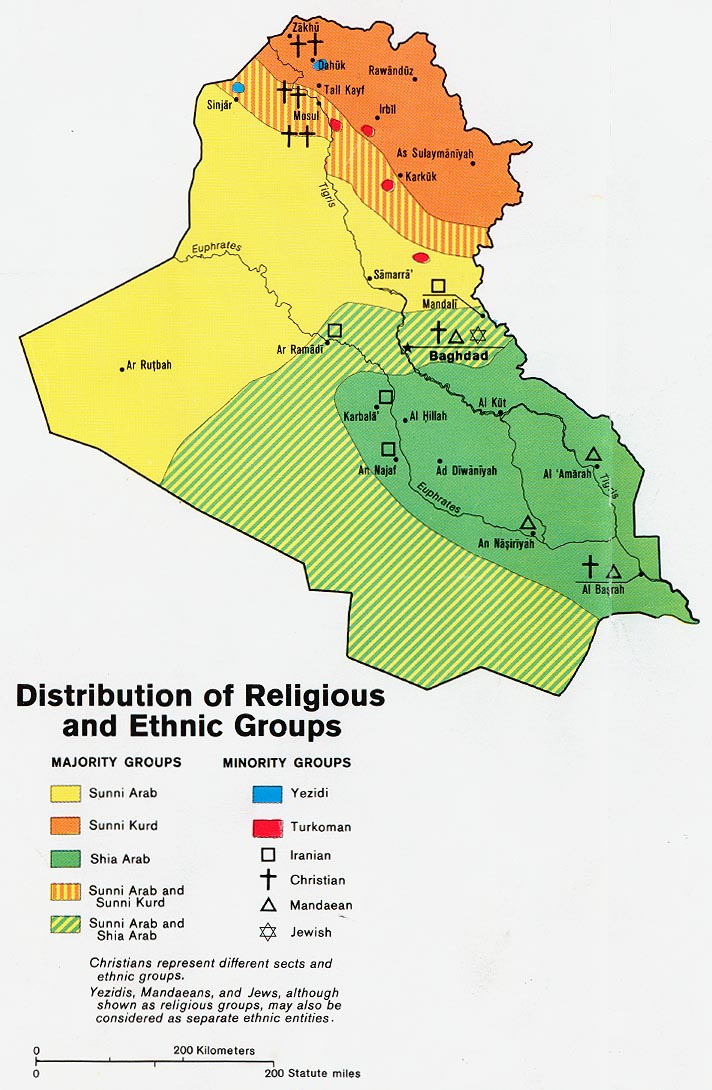
The Shi'a are the majority population in Iraq, and thus they have been swept into power by the recent Iraqi elections. Many of them have been using their newfound power to exact revenge for decades of Sunni oppression. These Shi'a are supported on a basic level by Iran, as their Shi'a dominated republic is an outcast like the Shi'a in Iraq from the majority of the Muslim world. As has been shown, the Shi'a and Sunni conflict goes back centuries, and the blood spilled between the two in Iraq has only deepend the divide.
The Kurds in the north still dream of their homeland of Kurdistan. They are a more secular bunch and their lack of desire for sectarian violence has caused their area to be more prosperous than the Sunni or Shi'a dominated areas in Iraq. In the future this unbalance of wealth coupled with Shi'a rule may prove to be yet another split. However, for the time being the Kurds have a loose alliance with the Shi'a against their collective Sunni oppressors.
The Sunni are in a state of cultural shock due to their loss of power. This is also unusual given the dominance of the Sunni sect throughout the rest of the Muslim world. Not only are they more apt to support the old regime and Ba'ath party run by Saddam (a Sunni), but they are angered by the death squads supported by clerics such as Al-Sadr. This is fueling the Sunni led insurgency against the new Iraqi government.
Al-Qaeda is also in Iraq. It has a loose affiliation with the Sunni insurgency, but its overall goal is simply to fight the Coalition forces.
Now, the Sunni overall dislike the coalition forces. The Shi'a as a majority feel that the coalition forces should leave the country. The only thing close to support that the coalition has comes from the Kurds. Other than that, the United States as picked western friendly individuals and helped to elevate them into prominant status within the government. This has generated much resentment towards the current government, which is at the same time powerless to rebel too far against its Shi'a support block.
Syria and Iran are also working to undermine coalition support within the region, and to establish an Iraqi government that is supportive of the regimes in Iran and Syria.
So, how does one solve all these complicated blood spilling conflicts when the only thing most seem to have in common is disgust with the coalition?
I would encourage all of you to read the Iraq study group report cited earlier, as it offers many potential solutions. However, I also attempt to offer mine using the perspective of Informationalism.
1. We have to be agressive about controlling the ability of the Iraqis to obtain weapons for the time being. A close crackdown on the boarder and a massive weapons exchange program should be initiated where guns would be exchanged for some other useful good.
3. This will be met with outrage from most of the Iraqi government. So the coalition must do some deal making. Greater autonomy must be allowed for the Kurdish and Sunni dominated areas of Iraq, in exchange for the giving up of militias. A system must also be set up for the sharing of country oil revenues.
4. With the destruction of the militias the Iraqi army and police force must be allowed to patrol the country in greater numbers. The coalition forces will take on more of an advisory role as they begin their withdrawl. The Iraqi government should be provided with UN and Arab League support to the fullest extent possible. This includes aid to the Iraqi people and the creation of large government works programs to bring the basic industrial structures of Iraq back online.
5. Massive amounts of aid must be given to the people of Iraq. In order to gain their support, the coalition must ensure that their basic needs are being met by their government. Currently, this is not being done effectively.
6. The coalition must build schools, as well as set up student exchange programs where Iraqi children can be taken to Western countries to be educated. I am aware this appears ethnocentric on the surface, but the western education system is far closer to Informationalism than Islamic education. Prisoners must also be offered a kind of education to make it more likely that they will not return to negative activity upon their release.
7. The coalition must hold talks with Iraq, Syria, and Iran with a moderator in order to come to border and trade decisions, as well as moderate the influence each power has upon the new Iraqi government.
Notes: The crackdown on the militas must be done within a 72 hour period. The military operation must be swift in order to ensure its effectiveness. After the deal of regional independence is reached under the table, the coalition must isolate as many insurgent and militia targets as possible, and eliminate them. This must be done with the help of the Iraqi army and police. Also, in order to do this, many more troops will be required. We currently have close to 150k troops in the country of Iraq. We must increase this number to at least 300k if we hope to establish any kind of peace.
What if we simply leave?
Then the country will descend into chaos.
What if we just keep the forces that we have?
This might be possible, but we will have to conduct many swift special operations in order to eliminate troublesome militia leaders. It will be a long arduous task and success is not nearly as likely.
One thing is for sure, what we are currently doing is not working. Any better ideas?
12/10/2006
Bad Religion - Cease
This is a song called "Cease" by Greg Graffin, the lead singer of Bad Religion. I chose it not only for the genius of the lyrics, but also for the beauty of its style. The concepts portray some of the philosophy of Informationalism through the eternal art of music.


