I think this video provides a good example about how one should consider events from different perspectives. Informationalism is about trying to rationally and empirically explore all assumptions, especially our presuppositions. This man has obviously put a lot of thought into his opinions, and feels very strongly about them. While I prefer a little more open-mindedness even in the face of rational and empirical certainty, it is certainly preferable to unexplored assumptions.
We all possess ideas be they religion or just every day assumptions that are untrue. They might not be untrue, they might just be ambiguous, but we still view them as true. This is because we've never taken the time to sit down and explore exactly why we think the way that we do.
So, my challenge to you readers is this: Whatever it is you feel is true with passion-stop- analyze why you feel this way. Try to imagine the world if it were false. Does it being false cause the world to make more sense or create contradictions. If so, are these contradictions real, or are they again something you have imagined to be true? It is an iterative method that I feel might clean up some of the misconceptions we all have and maybe lead us to more exciting possibilities.
I like to think we make many of our assumptions as if we were operating in a dream. There are glaring contradictions in our thoughts all around us, yet we do not notice them. Thus I implore you to stop for a few moments and consider your thoughts. Notice.
9/11/2007

9/10/2007
I think this video speaks to some of the founding principles behind Informationalism. It took quite a bit of introspection and rational inquiry before I came to what I like to call the root cause. The root cause is my idea that all activity is ultimately for the purpose of the survival of the species. Every thought, every action, stems from a basic biological drive to proceed into the future. It is by acquiring more and more Information that we better our pursuit of this root cause.
This drive can be manipulated, redirected, or perhaps fooled by outside forces. But the drive remains, and its primary purpose is written in all of us. Informationalism is attempting to take this root cause to its logical conclusion. Through the free acquisition and distribution of Information we are able to explore which of our actions serve the root cause. Often, we may find that many things, even things like religion which we hold precious, are and have been used as tools to manipulate and deceive this primary drive.
But, as this song tries to reach out and tell us: we must explore ourselves from the inside. That is where real change begins. In my case, as my theory has led me to believe, we discover the paradox of our own simultaneous insignificance and indespensibility. Every human being is different. We all have different ways of processing information which allow all of us to contribute something new. Remember this.
9/08/2007
Technique Perfection(An Example)
I made a post not too long ago about Technique perfection and Informationalism. The idea stemmed from some thoughts that I had while swimming laps. I was using my body to swim, a technique I've tried to refine, and at the same time working on mathematical calculations in my head whilst keeping up with my laps. It was a very trying experience, but I was successful, and here is why:
I devoted a great deal of time to refining my swimming technique. So much so that doing the activity no longer required much effort from my conscious mind. My conscious mind was free to practice other things.
So the conclusion that I drew was that it was good to focus on practicing some kind of technique until the delay between thought and action is erased. Then to build and refine other techniques while doing that activity. Building one technique upon another is, in my opinion, a great way to increase the flow of information.
So, without further ado, here is my real world example of absolute technique perfection. As well as a word of warning. Jimi Hendrix was without doubt the quintessential master of the electric guitar. Listening to what he created is a marvelous thing in my opinion. But it's also a reminder than singular obsession with an art has its dangers. While striving to become a "master" at something is good, it should not be the only goal of the individual. The goal is to try and "master" as many arts as possible. It is only then that we can explore the connections between the mind and the body in ways our current vocabulary cannot express.
9/07/2007
Informationalism: What should supporters do?
Many of you have followed my posts over the past year or so. It's been an intellectual experimental journey that continues. I hope to be able to offer more of my thoughts, opinions, and possible solutions in the future as always. However, despite my hesitance, I would like to extend the experiment by thesis three of the current theses of Informationalism which states:
"3. "The question whether objective truth can be attributed to human thinking is not a question of theory but is a practical question. Man must prove the truth — i.e. the reality and power, the this-sidedness of his thinking in practice. The dispute over the reality or non-reality of thinking that is isolated from practice is a purely scholastic question."
Thought is very important. But action is the most important part of a paradigm or philosophy. How well does it work in action.
 I would like to begin the phase of discussion. As I stated in earlier posts, the beginnings of Informationalism arise when groups of people(or just an individual) are compelled to form a kind of free thought society or community. A group that serves as a temporary meeting place where ideas can be shared, conclusions drawn or explored, and overall knowledge increased. An individual can do this simply by engaging another group or individual in a conversation of these means.
Keep in mind, however, as always. That the telos of these actions and conversations is to gather information for the purpose of improving yourself, and your society. All this to the end of ensuring the survival of greater humanity. In an Informationalist conversation, never lose site of its purpose.
Therefore: those of you who are interested in Informationalism might consider forming a group with others that might feel the same way. Or simply engage others by yourselves. Ask them if they feel that the perpetual survival and development of the species is important. Ask them how this might be done. Exchange ideas, form new ones, and think of ways to put them into practice. And remember always that this hinges ultimately on the freedom of information. You must be frank, you must be open, you must truly be free.
**As always, these are my opinions regarding the philosophy of Informationalism. I feel that they show promise, and I desire to expand them into real world experimentation. For those of you who might desire to help me and others by doing this, I would be pleased. For those of you who feel differently, I respect your difference. And for any who might be hostile to what I have said here, know that I harbor no ill will towards any sentient creature.
8/24/2007
It's been a while since my last posting. Safe to say I've been doing a lot of thinking about Informationalist philosophy of the past months. First I'd like to encourage you to check out a BLOG one of my friends made. It's an interesting idea that I think merits a little publicity.
There are two new concepts I wish to integrate into the Informationalist philosophy. The first is initiative.
Initiative in the Informationalist sense acknowledges the need of the shift of an equilibrium for an organism to adapt. It CANNOT be taught, but it MUST be learned. Central to the philosophy of Informationalism is the desire of the individual organism to survive. I have spoken in the past about the deep connection between the perpetuation of the individual and the perpetuation of the species, and how it is all wrapped up within the free flow of Information.
Thus, initiative becomes important to Informationalism. One must use information to change their surroundings in order to better meet their require equilibrium for their own survival. However, without ALL DATA the equilibrium constantly shifts due to unforeseen interactions in the universe. It is here that initiative becomes important. It is the initiative to master one's
 environment once again that makes the data and thus Informationalism perpetually important.
Technique Perfection in the Informationalist sense is something I discovered within the philosophy of Zhuangzi. It is the continual practice of an art so that the boundary between the conscious and unconscious mind is obliterated. For example, the simple action of typing on the keyboard. I am quite adept at my usage of "home row". So adept that I no longer have to think about the position of the letters that I am about to type. As I type this post, I can simply let my thoughts flow onto the screen via the keyboard. Due to my mastery of the skill, there is no visible delay between the processing power of my mind due to locating the letters on the keyboard. I simply know where they are.
Technique perfection is important because of its ability to allow individuals to successfully multitask. Being able to do this makes it possible to produce and acquire more information. It also gives the individual a greater power and understanding of the self and the environment. All of these things are crucial to Informationalism.
Another example of practicing technique perfection I found took place while I swam laps. As I swam I calculated the distance I planned to swim, and adjusted those numbers numbers into other units. I did all this while swimming and keeping up with the current amount of distance I had already covered. It was exhausting, but rewarding.
I would encourage those who read this to attempt to practice technique perfection. Even if you are not an Informationalist. Learn a skill so well you don't have to think about it when you peform it, and then master other tasks while performing that skill. This obviously has its limits, you cannot use a keyboard and weave something at the same time. But activities that do not seriously overlap could be mastered at the same time, increasing one's ability to multi-task and acquire new Information. I hope this has been helpful.
4/27/2007
Carl Sagan - Pale Blue Dot
I think this right here pretty much says it all when it comes to the significance of humanity. We are wrapped in such a paradox. The earth is everything and yet it is just a pale blue dot. Humanity is everything and yet it is nothing. I use this for Informationalism because I think it shares the spirit of wonder that Informationalism tries to capture. It is with the knowledge that we are this "pale blue dot" that we should feel compelled to drop our petty stereotypes and strive to uncover the vast mystery of the universe in which we live.
3/01/2007
1. The fundamental problem with materialism is that it does not take into account the influence of information. It is in the ability to record, pass on, and understand information that the advanced manipulation of material circumstances becomes possible.

2. The only way to value a species is by its ability to expand and perpetuate the information it acquires over time. A species that cannot do this must in time be overcome and eliminated by their material circumstances.
3. "The question whether objective truth can be attributed to human thinking is not a question of theory but is a practical question. Man must prove the truth — i.e. the reality and power, the this-sidedness of his thinking in practice. The dispute over the reality or non-reality of thinking that is isolated from practice is a purely scholastic question."
-Marx; Theses on Feuerbach II
4. Asymmetric Information leads to social distinction, especially within humanity. Oligopolies of materials and Information are inefficient. Thus a species with asymmetric information is not maximizing its value and risking its existence.
5. Ensuring free distribution and acquisition of Information is the only way to maximize the value of a society. Therefore the goal of a human society must be the freedom of information and the subsidizing of its acquisition in all fields.
6. The laws and structure of society must be formulated and adapted to the practical judgement of acquired Information. Society should be based on conclusions stemming from the best tested Information, and adapt to reflect the consensus of the Information.
7. "The free communication of ideas and opinions is one of the most precious of the rights of man; every citizen can then freely speak, write, and print, subject to responsibility for the abuse of this freedom in the cases is determined by law".
-11th Declaration of the Rights of Man and the Citizen (August 1789)
2/24/2007
Richard Dawkins - "There is no such thing as a Christian Child"
I thought you all might find this interesting and insightful. I know that Informationalism is not explicitly atheist; my closest examination has led me to conclude that Spinoza-like Pantheism or weak Atheism are probably the best approaches to Informationalism. I posit a simple redefinition of the terms so that Atheism and Pantheism become one.
I feel this movie links up my last post, because it shows the harm that can come from forcing unfounded dogma onto children. I would not even condone labeling a child as a Informationalist child. It is a matter of choice that must be made at an age of consent.
I'm showing this in the hopes that all of you will take an opportunity to take another look at your own faiths; to try and discover where you may be dogmatic. I'm asking, as always, that you consider the benefits of the possibilities that come with Informationalism. Finally, it is my hope that some of you might decide to help pick up the cause, and embrace this progressive philosophy.
2/18/2007
Why Our Country Needs Informationalism
I think this article says it all my friends:
http://news.yahoo.com/s/ap/20070218/ap_on_re_us/evolution_jews
Here is the website: http://www.fixedearth.com/
State Rep. Ben Bridges of Georgia has been affiliated with a memo passed around the political scene which decries Science and attempts to replace it with the Pseudoscience of a man named Marshall Hall. Hall is the President of the "Fair Education Foundation". The name of the organization itself is an example of the disinformation that those frightened of the freedom of information will promote. There is no fair education for this man, there is only the age old
To sum up this ridiculous website promoted by a ridiculous excuse for a representative. It attempts to show the public how the modern model of the universe and evolution are mere products of a "zionist agenda". Of course, one wonders why they chose to lump these two areas of study together specifically. It is because they are both threats to Christianity.
Informationalism wishes to promote the freedom of information. There is no problem with the creation of such information, the problem is that this website parades incorrect information as correct information. By doing this it also engages in disinformation. The result? A deliberate misleading of the public. This website is fraud; it is an example of all that a society without freedom of information can be subjected to.
A final thought. Imagine if a child who knew little about the subject were to stumble upon this website. The influence that it could have upon their ability to think critically would be catastrophic. For the sake of free information and free society we must let it be known that fraud and disinformation cannot be tolerated.
2/13/2007
The seminar on the situation in 
The city of
However, the city obviously had planned to grow, and so decided expansion and drainage of the swampland in coordination with development would be the best strategy to take. They undertook the paradox that the speaker referred to as making unsafe land safe. The swamp land was drained, causing the dried up soil to compress and sink below sea level. It was then placed behind levees for protection that were only designed to withstand category 3 Hurricanes.
The danger was realized, and the city was sued for failing to adequately maintain the pump systems to keep the water out. However, the development of
The area that had been swamp land which was developed quickly flooded as it was already under sea level. It should be noted that the area built on the natural dunes was spared a large amount of the destruction. The levees could not withstand a category 4 Hurricane, and so they broke. Since the levees were made in one large wall, a single breech caused the water to pool in the area below sea level and then become stuck, prolonging the flooding. This was also combined with failure to communication between the national and local level of government.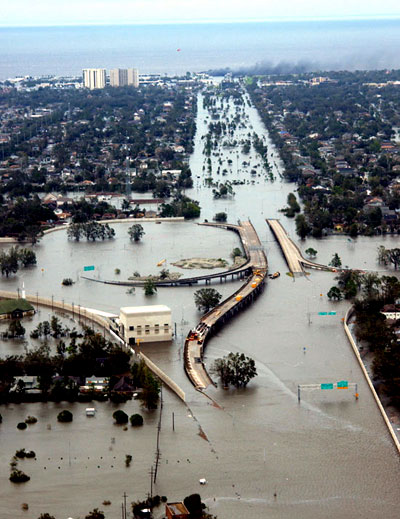
The results were that thousands were killed, billions of dollars in damage was suffered, and thousands of people were left homeless and forced to move outside of the city. All of this could have been avoided with proper planning.


